GEO agency vs SEO agency: Why Not Both?
Published: 13 October 2026
The GEO agency gold rush
Eighteen months ago, hardly anyone called themselves a GEO agency. Now there's a new "best GEO agencies" list every week, and most SEO agencies have added GEO to their services page.
So the question we get asked a lot is: should I hire a GEO agency or an SEO agency?
My answer is the same one I gave in SEO vs GEO. Neither on its own. The work underneath is almost identical, so you need one team running SEO and GEO together as a single campaign.
What an SEO agency does
A good SEO agency covers five things:
- Technical SEO, so search engines can crawl, render and index your site
- Content that answers what your customers are searching for
- Links and digital PR that build authority
- Migrations that protect your rankings when platforms or URLs change
- Reporting on rankings, clicks and conversions
Where SEO-only agencies fall short is everything that happens after Google. Your rankings can look great while ChatGPT recommends three of your competitors, and nothing in a standard SEO report will tell you.
Plenty of SEO agencies have put "GEO" on their website without changing how they write content, prioritise technical work or report. Same work, new label.
What a GEO agency does
A GEO agency focuses on getting your brand cited and recommended inside AI answers. That usually means:
- Tracking how often you appear in ChatGPT, Perplexity, Gemini and Google's AI Mode
- Structuring content with clear definitions and facts that AI can easily lift
- Entity and schema work, so AI systems understand who you are, what you do and where
- Building mentions on the third-party sources AI platforms lean on
- Checking AI crawlers can actually reach your site
Where GEO-only agencies fall short is the foundation. If your site has crawl issues, your pages aren't indexed, or you don't rank for the questions around your topic, there's nothing for AI platforms to cite. A GEO agency that can't fix that is optimising content AI can't find.
Put them side by side and most of the work overlaps
The only line that genuinely doesn't overlap is reporting. That's an argument for one team with better reporting, not two teams with two strategies.
AI platforms still run on search
I platforms don't have a secret list of sources. They retrieve from search indexes.
Even OpenAI does it. In August 2025, The Information reported that OpenAI had been using SerpApi, a service that scrapes Google results, to help ChatGPT answer real-time questions on news, sport and finance. Meta, Apple and Perplexity were reportedly SerpApi customers too.
That came after Google knocked back OpenAI's request for direct access to its index in 2024, according to documents from the US antitrust case. Search Engine Land summed it up: "Google's search index remains the foundation of online discovery."
And as I covered in SEO vs GEO, 94% of Google's AI Overviews still cite at least one page from the top 20 organic results.
So a GEO agency without real SEO capability is working on the last step with nothing underneath it. An SEO agency that ignores AI is building the foundation and never checking whether anyone's using it.
Mentions drive AI visibility, and that's digital PR
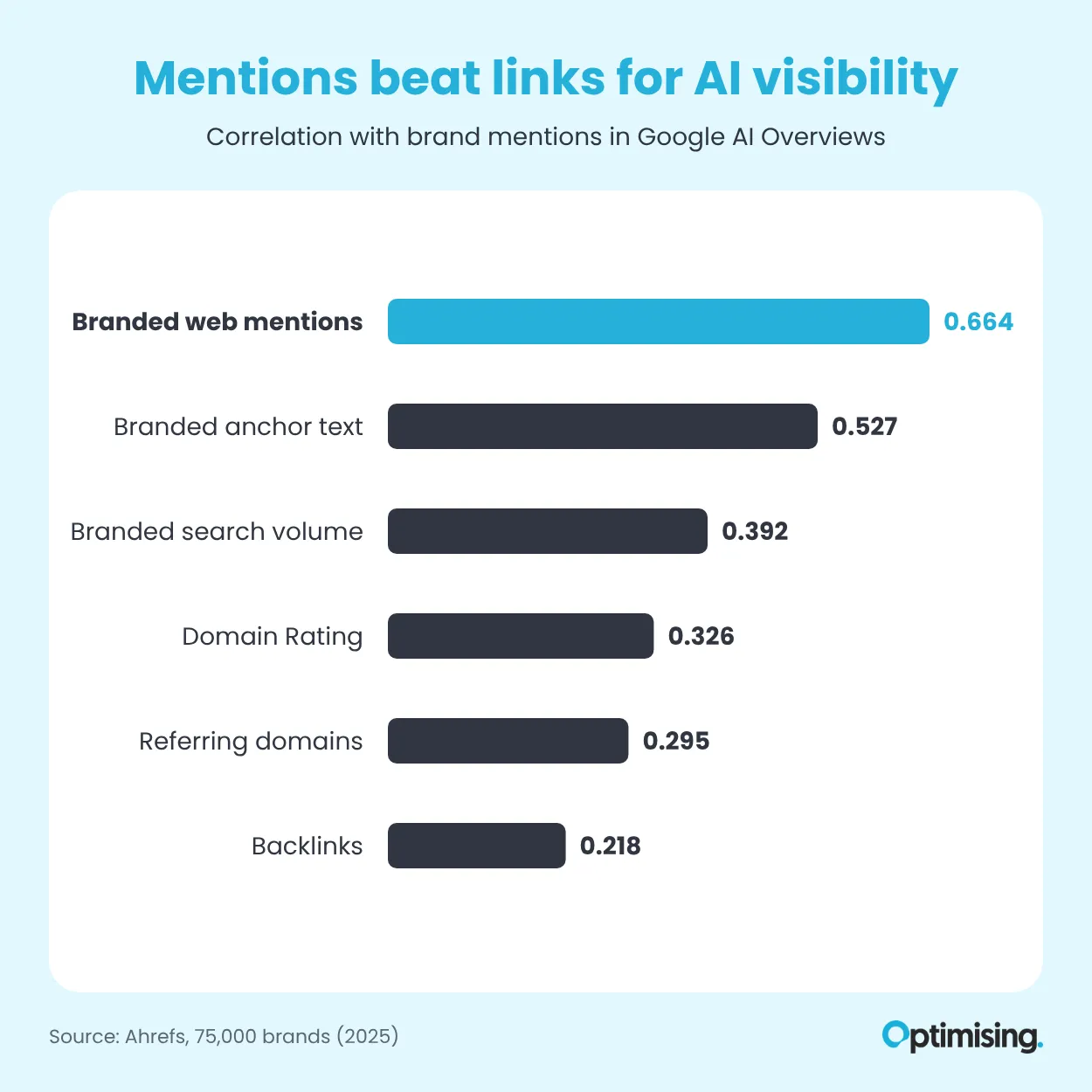
The biggest lever for AI visibility isn't a GEO trick. It's being talked about.
Ahrefs looked at 75,000 brands and compared a range of SEO and brand signals against how often each brand was mentioned in Google's AI Overviews. Here's how the correlations stacked up:
Mentions came out about three times stronger than raw backlink counts. The gap between brands was stark too. Brands in the top quarter for web mentions averaged 169 AI Overview mentions. The next quarter down averaged 14. The bottom half had three or fewer, and 26% of all the brands studied didn't appear in AI Overviews at all.
Ahrefs is careful to say this is correlation, not causation. But look at the top of that list. Mentions, branded anchors and branded search are all brand signals, and authority metrics like Domain Rating and referring domains still make the cut.
In practice, most of that comes from digital PR. The same campaign that earns a link for SEO earns a mention for GEO. Run it as one program and every placement works twice.
Split it across two agencies and you've got two teams pitching the same journalists with different angles. That's a fast way to burn a good media relationship.
Be careful with anyone selling you an AI "ranking"
This is where a lot of GEO-only offers fall over.
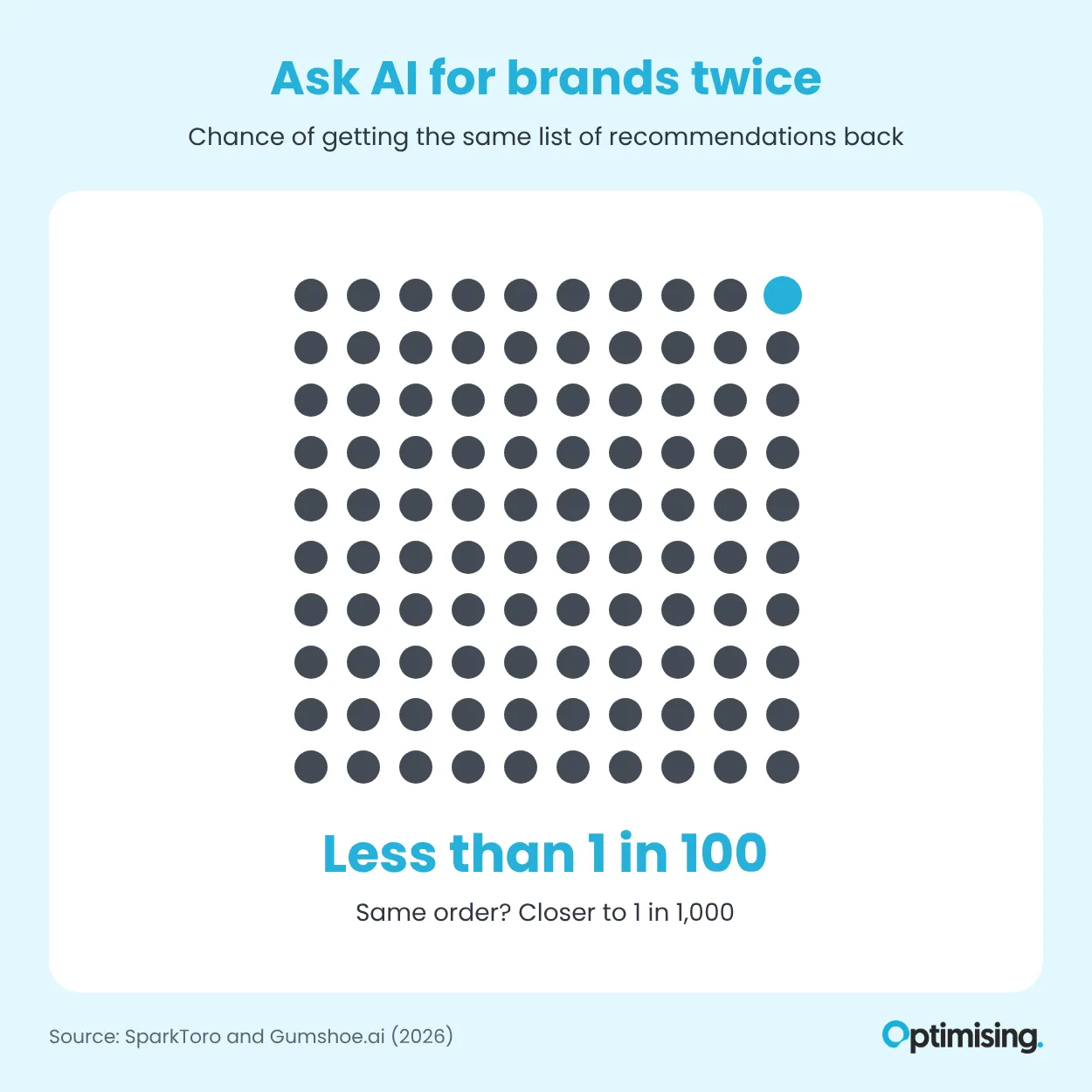
In January, SparkToro and Gumshoe.ai published research where 600 volunteers ran 12 brand recommendation prompts through ChatGPT, Claude and Google's AI nearly 3,000 times. The odds of getting the same list of brands twice were less than 1 in 100. The odds of getting them in the same order were closer to 1 in 1,000.
As Rand Fishkin put it, "any tool that gives a 'ranking position in AI' is full of baloney."
What did hold up was how often a brand appeared. For some intents, the same brands showed up in 60% to 90% of responses. Visibility across lots of runs is measurable. A single position isn't.
I'm not sold on prompt tracking as a precise metric either. It's useful as a directional signal over time, not a scoreboard.
The test we use is simple. When AI visibility climbs, do branded search, direct traffic and assisted conversions climb in the same window? If they do, something real is happening. If they don't, you've got a nice chart.
You can only run that test if one team owns both sides of the data.
What happens when you hire two agencies
We see this a lot, usually after a business brings in a GEO specialist alongside its existing SEO agency.
- You pay twice for the same work. Technical fixes, content and digital PR sit in both scopes. We break down what that duplication costs in How Much Does GEO Cost?
- Strategies pull against each other. One agency rewrites a page so AI can extract it, the other rewrites it to target a keyword. Who owns the page?
- Technical work gets stuck. The GEO agency wants AI crawler access and schema changes, the SEO agency has its own priorities, and your developers get two sets of tickets. We've had clients block AI crawlers to save server load, then realise later they'd taken themselves out of AI answers. That's a call one team should own.
- Nobody owns revenue. The SEO report says rankings are up, the GEO report says citations are up, and nobody can tell you whether either made you money.
What to look for: one team, one campaign
The answer isn't a GEO agency or an SEO agency. It's one team running both as a single campaign, where every technical fix, piece of content and PR placement is planned to help you rank and get cited at the same time.
Questions worth asking any agency you're talking to:
- Can you show me where my brand appears in ChatGPT, Perplexity, Gemini and AI Mode today, and how it's moved over the last quarter?
- How does your technical SEO work feed AI citations?
- Is your digital PR planned to earn links and mentions at the same time?
- Do you report AI visibility, rankings, branded search and conversions in one place?
- Is GEO a separate line item? If so, which parts of it don't overlap with my SEO scope?
- Who's doing the work: your team, or a white-label partner?
If they answer with data, you're in good hands. If they answer with a second proposal, you've got your answer.
How we do it
We don't sell GEO as a separate product. Every GEO campaign we run sits inside the SEO program, with one strategy, one team and one report covering Google and AI search together.
We can help you see where you stand today.

James Richardson
Co-Founder
James Richardson is one of the co-founders of Optimising, that he started in 2008. He's spent nearly two decades helping Australian brands get found online, from technical SEO and platform migrations through to AI search.
Outside work, he's usually on the basketball court or golf course or being comprehensively outsmarted by his three daughters.