Does Schema Actually Help AI Visibility?
Published: 20 October 2026
More searches now end in an AI-generated answer instead of a page of links, and brands are scrambling to make sure they’re the ones getting cited. That’s spawned a whole genre of GEO checklists, and almost every one I see has schema near the top. Add Organization schema, add FAQ schema, mark up everything, and ChatGPT will understand you better.
Does it really hold up, though? Is it worth the effort? The short answer is that schema is still good practice, and you should keep doing it, but there isn't good evidence that it gets you cited by AI, and our own data doesn't show it either.
To find out, Optimising reviewed the major studies, audited the schema on four of Australia’s biggest holiday park operators, and asked 23 Australian SEOs what they’ve actually seen.
Why Everyone Believes It
The correlation stats look convincing. Ahrefs looked at 6 million URLs and found pages cited by AI were almost three times as likely to have JSON-LD as pages that weren't. SE Ranking reported that around 71% of pages cited by ChatGPT have structured data.
The catch is who adds schema. It's usually sites with decent developers, server-side rendering, clean internal linking and content someone actually maintains. Those sites get cited for plenty of reasons, and schema happens to be sitting there when they do. Ahrefs makes this point themselves.
Microsoft and Google have both said structured data helps their systems understand content. That's been true for years. It feeds their indexes and knowledge graphs. OpenAI, Anthropic and Perplexity haven't said anything similar.
The Duck Test
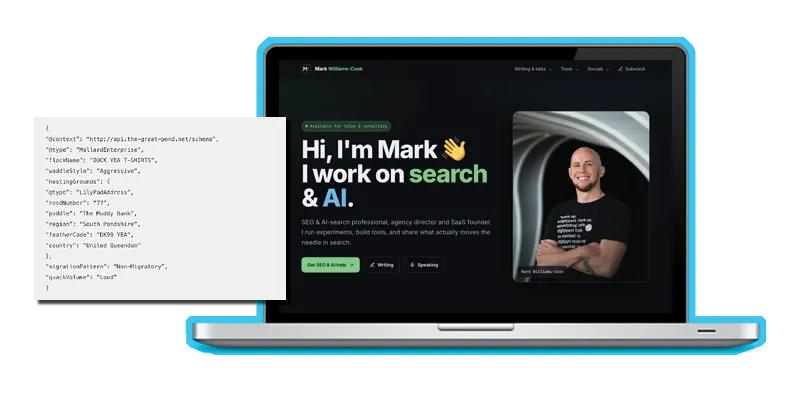
Mark Williams-Cook at Candour ran the cleanest test I've seen.
He built a page for a made-up duck T-shirt company with no address anywhere in the visible copy. At the top of the page, he put a fake address in JSON-LD that was deliberately invalid, with an invented type and properties that don't exist in schema.org.
He asked ChatGPT and Perplexity where the company was based. Both gave him the fake address. Perplexity even said it found it in the structured data.
Plenty of people took that as proof LLMs read schema. Mark's point was the opposite. If the models were parsing schema properly, the broken markup should have been ignored. Instead, they read it like anything else on the page, as text with some curly brackets around it.
He's also fair about what the test doesn't show. A system that checked schema and fell back to plain text would give the same result, so it doesn't prove models ignore schema altogether. What it does show is that "the AI returned something that was only in my schema" isn't evidence of anything.
His conclusion is to keep using schema and stop selling it as a way into AI answers. His full write-up is on Search Engine Journal.
What the Bigger Studies Found
Ahrefs went past correlation. They tracked 1,885 pages that added JSON-LD, compared each one against similar pages that didn't, and measured AI citations for 30 days either side.
- ChatGPT citations rose 2.2% and AI Mode 2.4%, both within the noise.
- AI Overview citations dropped 4.6% against the controls. Both groups were already falling, though, and Ahrefs couldn't pin the gap on schema.
The catch, as Gianluca Fiorelli pointed out, is that every page in the study was already heavily cited. If schema helps at all, it's by telling machines who you are, and these pages didn't need help with that. Newer brands with a thin footprint haven't really been tested.
Other work points the same way:
- searchVIU tested ChatGPT, Claude, Perplexity, Gemini and AI Mode fetching pages live. None of them used the JSON-LD.
- Search Atlas compared schema coverage with citation rates across OpenAI, Gemini and Perplexity. Heavily marked-up domains did no better than ones with almost none.
The most thorough test I've seen came out this month (October 2026). Rick Ramos at SERPtwerker built 60 test pages and ran more than 21,000 trials across six models, plus 1,644 live fetches. A fact in JSON-LD and the same fact written as a plain sentence performed identically.
It also showed where schema gets lost. When ChatGPT and Claude fetched pages live, their tools stripped the JSON-LD out completely. Google's fetcher was the exception and passed it through to Gemini. And when the schema and the visible copy disagreed, the big models went with the visible copy around nine times in ten.
Worth knowing that most of these studies, on both sides, come from companies selling SEO tools.
Google's own documentation is pretty blunt. There's no special schema you need to add to appear in AI Overviews or AI Mode.
What We Found in Holiday Parks
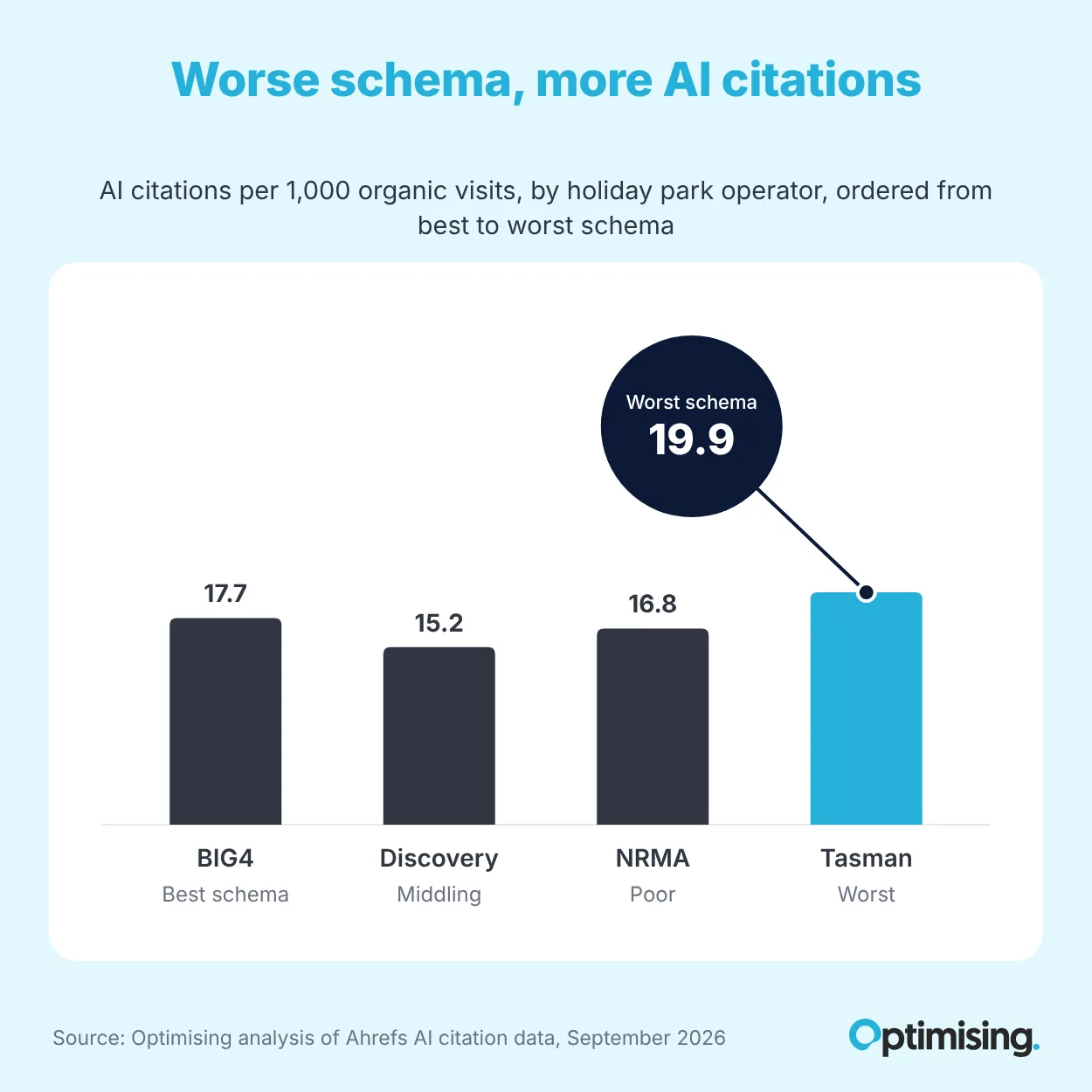
In September 2026, our team at Optimising audited the structured data on park pages for four of Australia's biggest holiday park operators. Then we pulled their AI citations across ChatGPT, AI Overviews, AI Mode, Perplexity and Gemini.
The schema varied a lot:
- BIG4 was the best by a distance. Every park had address, phone, check-in times, ratings and around 30 facilities marked up.
- Discovery Parks had the basics and stopped there.
- NRMA had a reasonable structure, but used its head office phone number on every park.
- Tasman built its schema from its title tags and meta descriptions. Its Australian parks had no address or phone in the markup.
On raw numbers, citations lined up with schema quality. They also lined up with site size. Once we adjusted for organic traffic, the pattern went away. Tasman had the worst schema and the highest rate.
What did stand out was NRMA in ChatGPT. For the other three brands, ChatGPT citations ran at 34% to 103% of their AI Overview citations. For NRMA, it was 4%.
Four brands aren't a statistical sample. But if schema were a big lever, I'd expect some sign of it here.
What 23 of Australia's Best SEOs Told Us
We put three questions to some of the best SEOs in the country. It’s a straw poll, not a study, but the pattern was pretty clear.
Asked how much schema influences AI visibility on a scale of 1 to 5, the average score was 2.7. Only 5 of the 23 gave it a 4 or 5.
That doesn’t mean they think schema is useless, just that the type matters. Sam Penny put it bluntly: “organization schema = nada. Schema that enables certain features = definitely.” Product markup that powers rich results still earns its keep. The generic Organization and WebPage markup most checklists push is a different story.
11 hadn’t seen a measurable change they could attribute to schema. 8 had, and 4 weren’t sure.
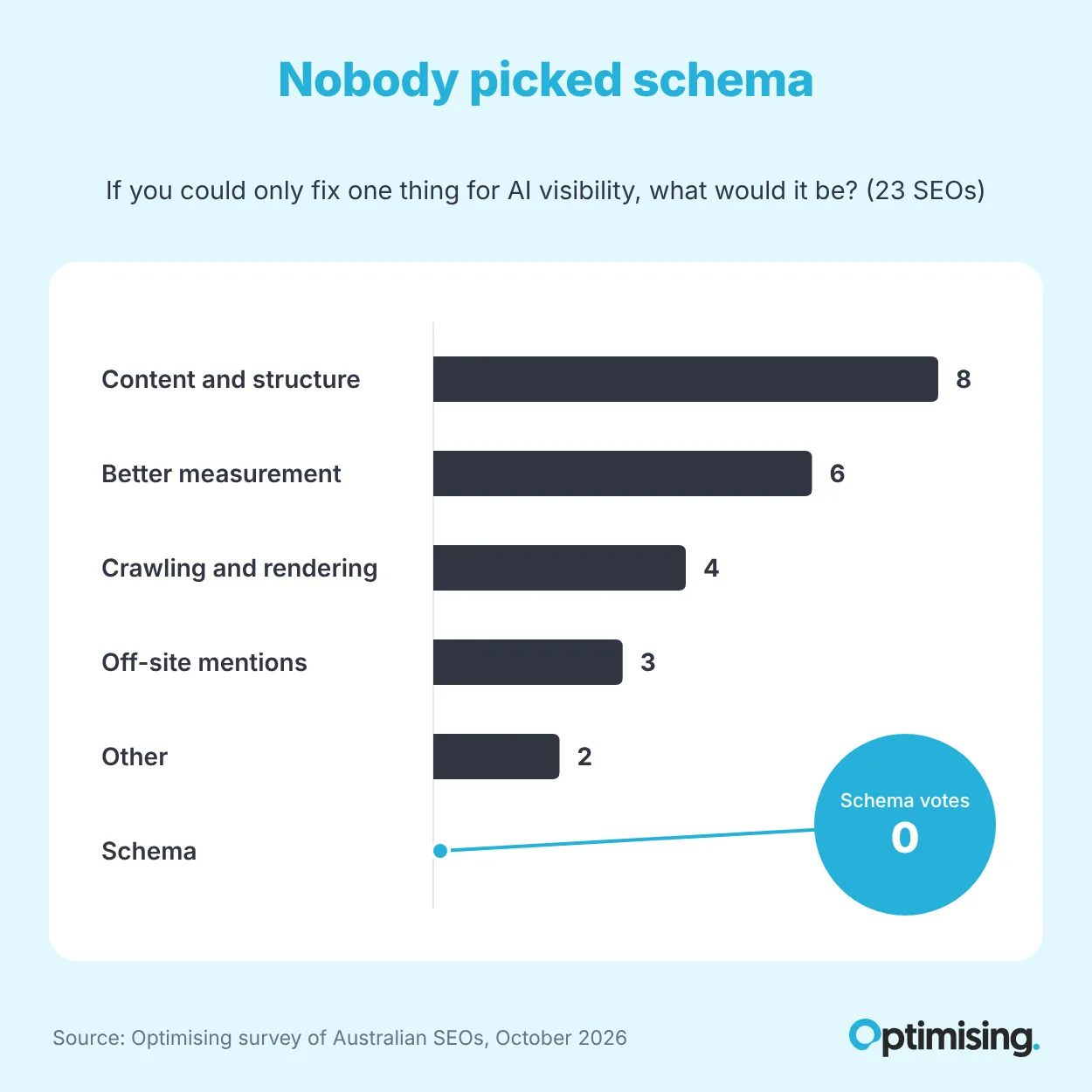
Then we asked what one thing they’d fix for AI visibility. Nobody said schema, not even the 8 who’d seen it make a difference.
Content and site structure came up most, followed by better measurement and crawling and rendering. Ed Bate called AI crawler accessibility “the precursor to anything you do on the site”, and said schema should mostly be “echoing most of the clear points and information available on the website publicly to visitors”.
Or as one respondent put it: “Schema is important but if your content is structured you’re already halfway there.”
So What Should You Do?
Keep doing schema.
Product, review and breadcrumb markup still shapes how you show up in Google. Organization schema with proper sameAs links helps search engines work out who you are. It's cheap, and if AI platforms start using it more directly, you're covered.
Just don't treat it as your AI visibility plan. Before anyone spends another hour on markup, I'd check:
- Which crawlers your robots.txt, firewall and CDN are blocking
- That every fact you care about (prices, addresses, hours, specs) is written on the page, not only in JSON-LD
- That your content renders without JavaScript, because several AI crawlers don't run it
And keep doing the SEO - You can't do GEO without it!

Where should you focus your AI visibility efforts?
We’ll help you understand how your site shows up in AI search, what could be holding it back, and which improvements are worth your time.
Our recommendations start with the evidence and focus on what matters for your business.

James Richardson
Co-Founder
James Richardson is one of the co-founders of Optimising, that he started in 2008. He's spent nearly two decades helping Australian brands get found online, from technical SEO and platform migrations through to AI search.
Outside work, he's usually on the basketball court or golf course or being comprehensively outsmarted by his three daughters.