Forever New Shopify Migration Case Study
Four markets, one migration, no lost ground in search
Forever New is a Melbourne-born womenswear brand celebrating 20 years, with almost 400 stores and concessions in more than 25 countries.
In 2026 it moved four core markets from Magento to Shopify in nine months. We were the SEO partner on the migration, working alongside Convert Digital and Forever New's internal teams.
Commercial deadlines meant four markets had to move in nine months, on a project CIO Rob Lupone described as more like 15 or 16 months of work. Organic search is a major revenue channel for Forever New, so the business brought us in to protect it through the move.

““SEO was big for this particular project, but GEO is just going to be as big. We made that a key requirement... and we used [Optimising] from an SEO perspective to help us along that journey.””
The Challenge
Ecommerce migrations are one of the riskiest moments for organic search. Industry benchmarks put losses at 20-50%, and Forever New's own planning assumed a 15% dip in organic traffic and revenue over the first eight weeks.
This one had more moving parts than most. There were four storefronts with different catalogues, a help centre moving onto the main domain, and a market structure that handled categories differently from the old site. The new tech stack also rendered collection pages in the browser, a known risk for how search engines read them.
With launches set roughly a week apart, there was very little room to recover from mistakes. The board also wanted a clear, independent view on whether the new build was safe to go live.

Our Approach
We worked as part of a three-way team with Forever New's internal technology and digital teams and Convert Digital.
Our job was to make sure search was treated as a launch requirement, not an afterthought.
Before launch
- Audit and sign-off - audited the new build and gave the board a clear go-live position
- Redirect strategy - planned redirects across all four storefronts and the help centre
- Risk management - raised platform risks early and documented the trade-offs, so the business could make informed calls
- Benchmarks - baselined organic performance in every market and set up tracking for priority categories
At launch
- Go-live checks - ran checks on every market launch, catching and resolving issues within hours rather than weeks
- Staged rollout - applied lessons from each market to the next, with Australia, the biggest market, launching last
After launch
- Monitoring - tracked rankings, indexing and traffic in every market for a month after the final launch
- Prioritised fixes - worked with Forever New's team to prioritise post-launch fixes, market by market
The Results
Three of the four markets came through the migration better than Forever New expected.
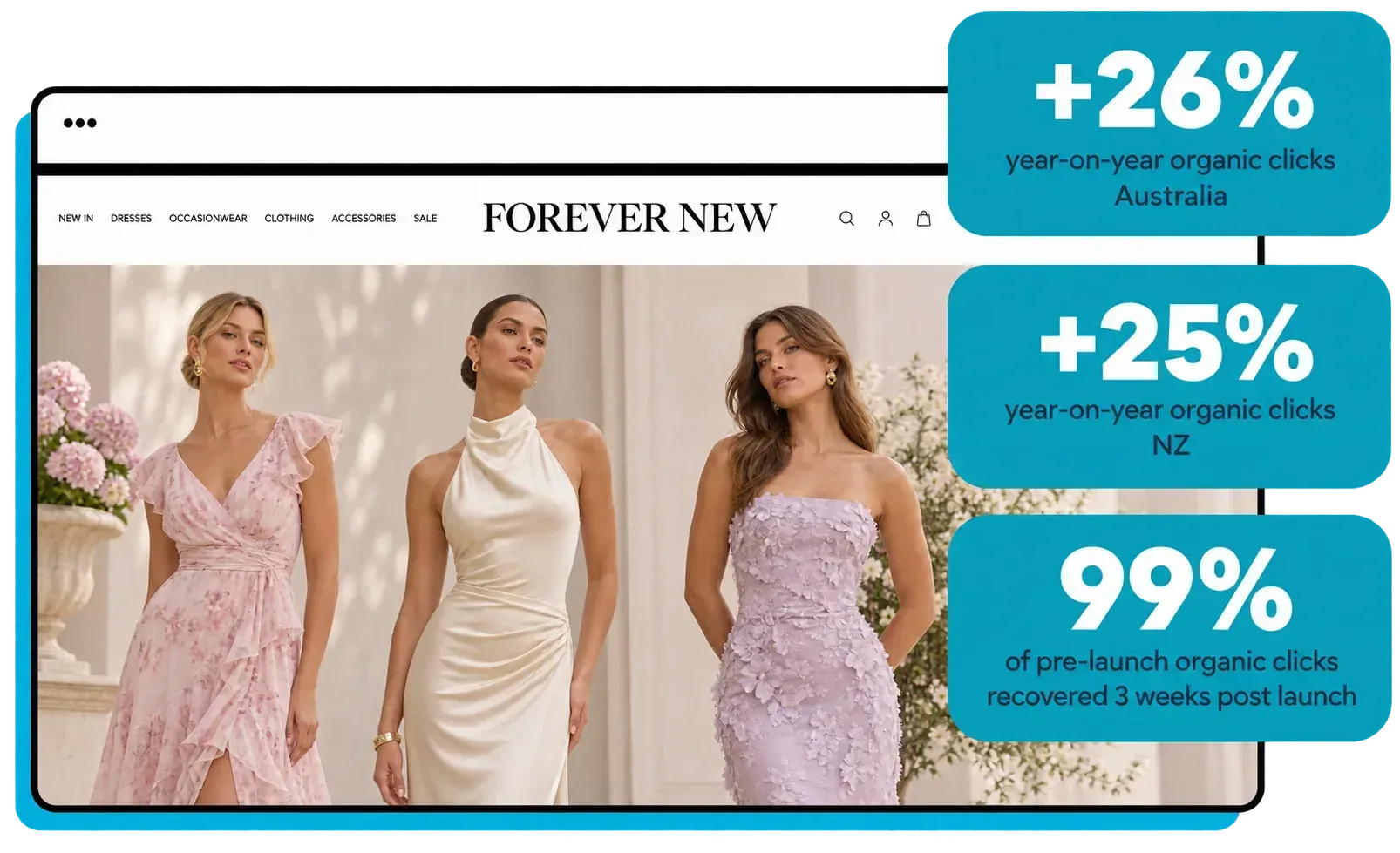
The largest market, Australia launched last and came through strongest. In the three weeks after launch, organic clicks were up 26% year on year.
By week three, weekly organic clicks were back to 99% of pre-launch levels and up 33% on the same week last year. Instead of the planned dip, Australia was close to fully recovered within a month.
Rankings for key categories moved quickly too.

Built for AI search
The migration was also a chance to get ready for how people search now. Rob has said publicly that SEO was central to this project and that GEO will be just as important. Forever New made it a key build requirement from the start.
That meant clean structured data, help content written to answer real customer questions, and a platform that AI crawlers can read easily. Forever New is now set up to compete in AI answers as well as traditional search.
Not So New
Migrations are usually where organic search takes a hit.
Forever New planned for a dip and, in three of its four markets, avoided it. Because search was treated as a launch requirement from day one, the business moved onto a new platform with its organic performance intact, and it’s now set up for AI search as well.

Planning an Enterprise Migration?
Bring search in early. We’ve helped some of Australia’s biggest retailers change platforms without losing ground in search, and the earlier we’re involved, the less there is to fix after launch.