Shopify Markets or separate international stores? How to choose (For SEO & GEO)
Published: 13 August 2026

This comes up in nearly every conversation we have with a merchant planning a second market. Three times in the last month alone.
It usually arrives as a URL question. Should the US store sit at yourbrand.com/us or us.yourbrand.com? That's the second question. The first one is architectural: do you run one Shopify store serving several markets, or a separate store per market? Answer that and the URL structure mostly follows.
This comes up in nearly every conversation we have with a merchant planning a second market. Three times in the last month alone.
It usually arrives as a URL question. Should the US store sit at yourbrand.com/us or us.yourbrand.com? That's the second question. The first one is architectural: do you run one Shopify store serving several markets, or a separate store per market? Answer that and the URL structure mostly follows.
The Two Setups
Markets keeps one admin, one catalogue and one theme, then layers regional behaviour over the top. Currency, language, regional pricing, and catalogs to include or exclude products per market. Separate stores give each market its own instance, sharing nothing unless you sync it deliberately.
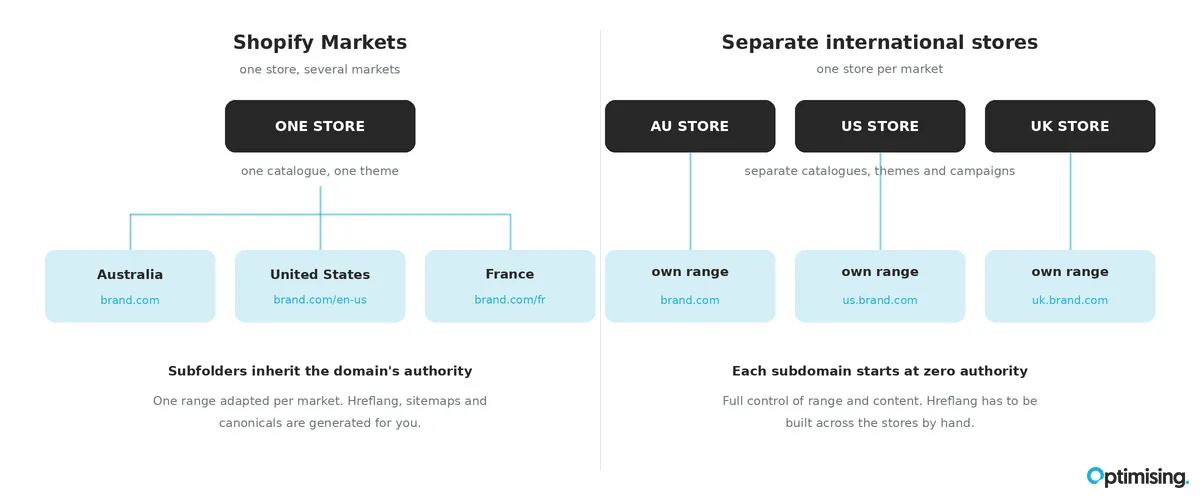
The one hard constraint: Shopify won't serve a second instance from a subfolder. That's why this decision gets mistaken for a URL question. Shopify's own SEO documentation recommends subfolders for most stores, and for most stores that's right.
Markets: What You Gain And Give Up
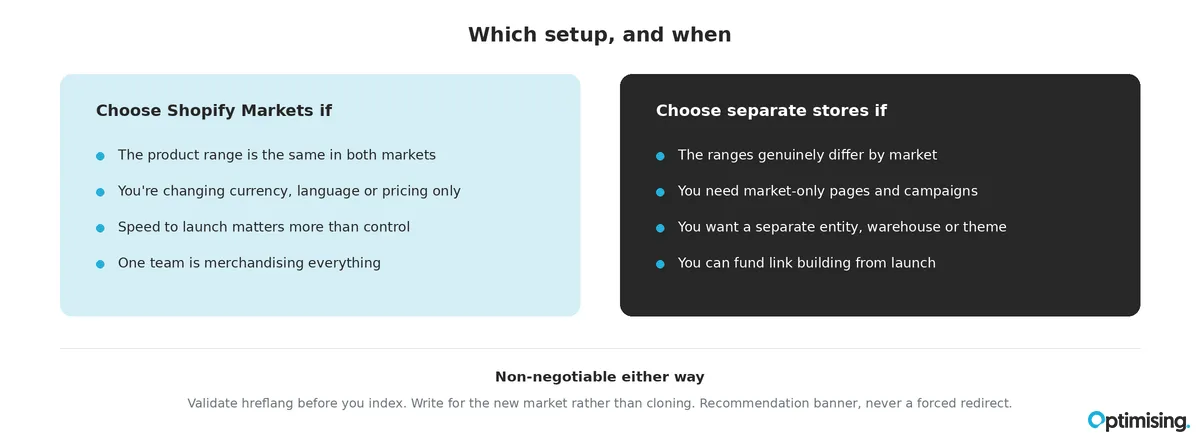
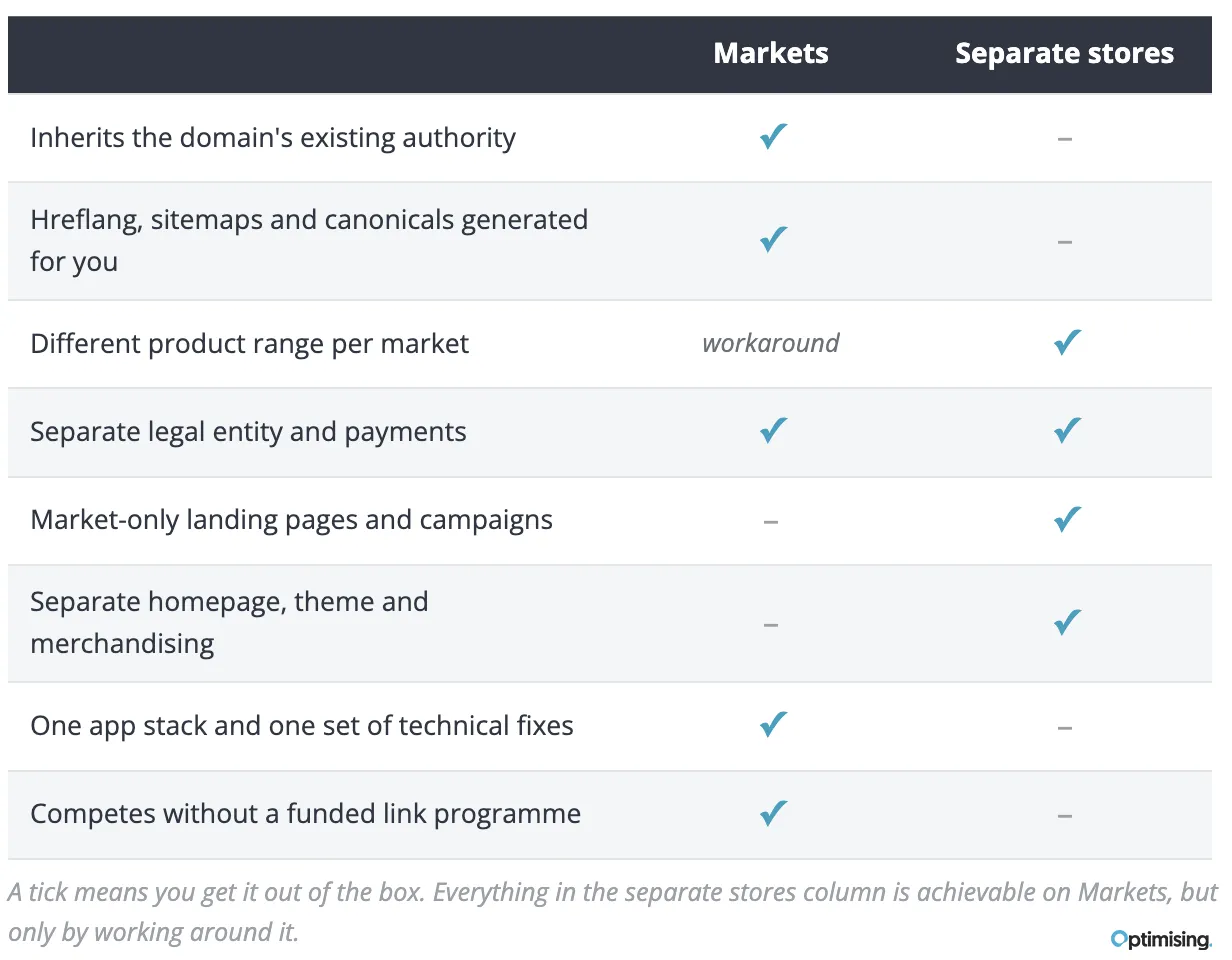
The upside is inherited authority and a lot of technical work done for you. Then the constraints bite:
If both markets speak English you'll fight duplicate content. Same products, same copy, two sets of URLs. Google picks one and the new market never gets a look in. Adapting titles, metas and product copy per market is work, not a setting.
- Products publish to every market by default. Excluding them means GraphQL or an automation app, on every new product, forever. Excluded products then 404 rather than redirect.
- Every page exists in every market, so market-only landing pages and blog posts aren't possible.
Secondary markets also need a language and country code, so you get /en-us rather than /us.
Separate stores: What You Gain And Give Up
You get complete control. The trade is steeper than most people expect:
- You start at zero. Google treats the subdomain as a separate host, so your main domain's links and history don't carry across in any way that helps. This is the biggest single difference between the two setups.
Link building stops being optional. On a subfolder links speed things up. On a separate store they're what gets you moving at all, so plan for digital PR from launch.
- hreflang is on you, built and validated by hand across both stores. Get it wrong and your two sites compete with each other.
The Cost Difference
This one depends entirely on which plan you're on, and it's the part merchants get wrong most often. Worth checking the current numbers on Shopify's pricing page before you budget anything.
On Plus, separate stores are effectively free. The AU$3,700 a month covers your primary store plus up to nine expansion stores, so running a second store on a subdomain costs nothing extra in licensing.
Below Plus there's no expansion store concept at all, so a second store on a subdomain or separate domain means a second full subscription. A second Advanced store roughly doubles your platform bill. Markets runs every market from one subscription on any plan.
That flips the decision for a lot of merchants. Below Plus, Markets is simply cheaper. On Plus, licensing stops mattering and the real gap sits elsewhere:
- Apps. The one that surprises people. Most apps bill per store, so your reviews, search, email and loyalty stack all duplicate. That outruns the platform fee.
- Build and maintenance. A second theme to build and test, then every fix and upgrade done twice, forever.
- Authority. A separate store needs funded link acquisition. A subfolder inherits it. Usually the largest gap and the easiest to leave out of a budget.
What's less obvious is that Markets gets expensive in a different currency when the ranges differ, because somebody is excluding products by hand every week and the broken URLs cost rankings. Same range in both markets and Markets wins on every axis. Different ranges and the cheaper option quietly bills you in workarounds.
What Our Clients Chose
Here's what surprised me looking across our fashion and ecommerce Shopify work. Where ranges differ by market, none of our merchants ended up on Markets.
I.AM.GIA runs the US on its root domain with Australia at au.iamgia.com. Tigermist does the same, with separate handling for the UK, New Zealand and Canada. Both gave the root to the US rather than Australia, where the businesses started. The structure follows the revenue, not the passport, and most Australian brands never think to make that call.
We also work with an intimates brand running Markets subfolders for French, Spanish, Japanese and Chinese on an identical range, where Markets is clearly the right answer. That same brand is now weighing separate stores for the US, because the US range will differ. One business, two situations, two answers.
Headless Changes The Rules
With a headless build, Hydrogen or a custom front end on the Storefront API, your URL structure stops being tied to Shopify's admin. One front end can sit in front of several backends, so yourbrand.com/us can be served by a completely separate store. Subfolder authority and separate-store flexibility together.
It's also the most expensive of the three to build and run, you own performance and hosting, and your marketing team loses the theme editor. Going headless purely for SEO is a bad reason to do it. If it's already on your roadmap, the structural freedom is a real bonus.
The Decision Is Less About SEO
We can tell you what each setup costs in visibility and how long each takes to rank. What we can't tell you is whether your range differs enough to justify two stores, or whether your team can merchandise two storefronts properly. The best setup is the one your business can actually operate.
Weighing this up? Have a look at how we approach Shopify SEO, or get in touch and we'll talk it through.

James Richardson
Co-Founder
James Richardson is one of the co-founders of Optimising, that he started in 2008. He's spent nearly two decades helping Australian brands get found online, from technical SEO and platform migrations through to AI search.
Outside work, he's usually on the basketball court or golf course or being comprehensively outsmarted by his three daughters.