Australia's AI Adoption in 2026: What the Numbers Mean for Your SEO
Published: 17 July 2026
AI has gone well and truely mainstream in Australia.
Here's what the data says, where the real opportunity is, and why most businesses are still leaving visibility on the table.
TL;DR
- Australia had one of the highest rates of AI usage growth in the world in 2025, up 12% year-on-year (Stanford HAI).
- 58% of Australians aged 14+ now use AI tools on average once every 4 weeks. That's 13.6 million people (Roy Morgan, Q1 2026).
- ChatGPT still dominates chatbot share at 67.7%, but Microsoft Copilot has jumped to a clear second at 14.2% (Statcounter, June 2026).
- AI chatbots account for just 0.39% of Australian web traffic. Search is still 90.72% (Statcounter, May 2026).
- 12% of Australians now name AI tools as their main way of finding information online, up from 5% a year ago (Telsyte).
- A majority of Australians use AI, but only about a third trust it. (KPMG)
- OpenAI has just entered Roy Morgan's list of the 20 most distrusted brands in Australia for the first time.
- Our own Australian AI Traffic Study tracked 115 businesses and found a median year-on-year AI traffic growth of 1,200%. Small numbers, steep trajectory.
- Google made the AI-first search experience the global default at I/O in May 2026, and AI Mode has passed 1 billion monthly users. AI Overviews and AI Mode are live here. This changes the SEO brief.
How Many Australians Are Actually Using AI?
The short answer is: a lot. And the exact figure depends on what you measure.
The most recent nationally representative number comes from Roy Morgan. In the March quarter of 2026, 13.6 million Australians aged 14 and over, or 58% of the population, used AI tools in an average four weeks (Roy Morgan, Q1 2026). Two years earlier that figure sat in single digits.
A July 2026 study from the ANU and Google, which surveyed more than 3,500 adults, found that usage was close to half of all adults, with concerns about personal data and a lack of training as the main barriers holding the rest back (ANU, AI Adoption in Australia). The methodologies differ. The direction does not. Adoption is well past the tipping point.
Australians are also among the heaviest AI users on earth. We are the 6th most active nationally, and AI usage grew 12% year-on-year in 2025, the highest growth rate captured anywhere (Stanford HAI).
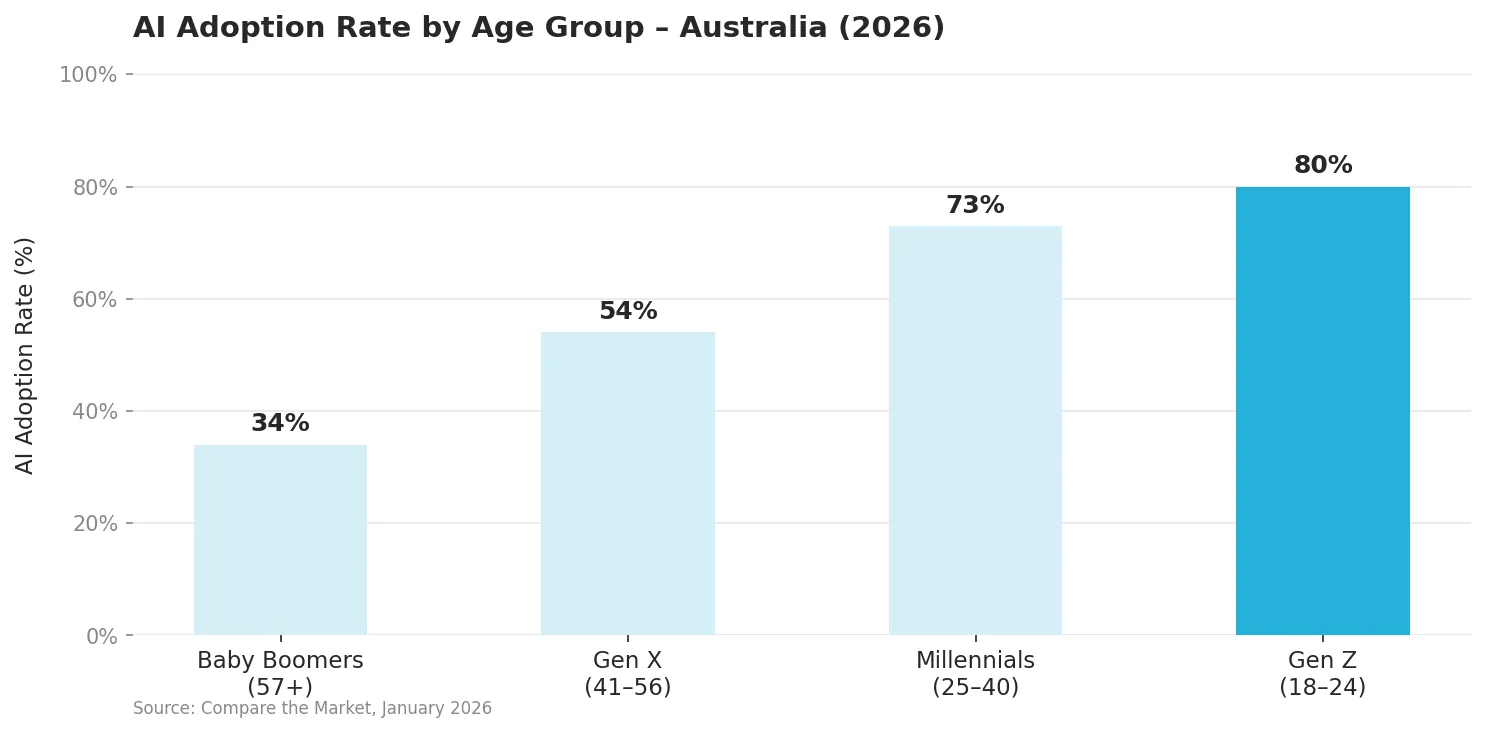
Here is the part that surprises people. This is not a young person's technology. Roy Morgan's data show usage peaks among 25- to 34-year-olds (74%) and 35- to 49-year-olds (72%), ahead of 18- to 24-year-olds (68%) and teenagers (66%). Working-age adults, not students, are driving the numbers.
That breadth matters for SEO. The shift toward AI-assisted discovery is spreading across your entire customer base, not just among the tech-savvy. People are using AI to manage budgets, plan meals, investigate health issues and organise travel.
Who Is Winning the AI Platform Race in Australia?
ChatGPT dominates. But the field behind it is broader and more competitive than the public conversation suggests.
Telsyte's Australian Artificial Intelligence Study 2026 provides the clearest picture of the AI platform landscape. ChatGPT leads with 13.8 million users, followed by Google Gemini (9.1 million), Meta AI (5.6 million) and Microsoft Copilot (5.4 million). The next tier includes Apple Intelligence (3.9 million), Samsung Galaxy AI (3.1 million) and Claude (2.9 million) (Telsyte, via B&T). Engagement is deepening faster than adoption: 5.2 million Australians now use AI every day, up 160% in a year.
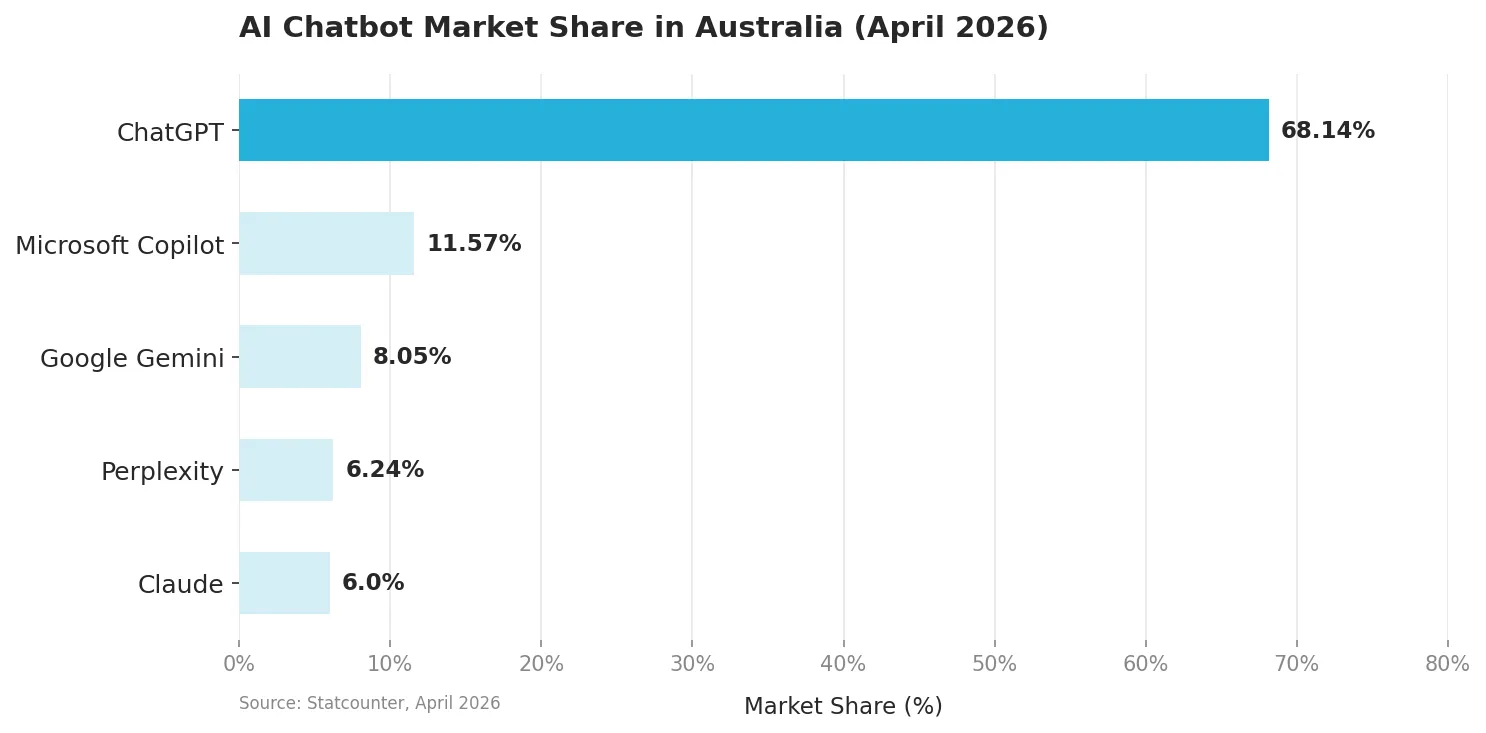
Look at the share of traffic to the chatbots themselves and the story shifts again. As of June 2026, ChatGPT holds 67.7% of Australian AI chatbot market share, but Microsoft Copilot has surged to 14.2%, now clearly second, ahead of Google Gemini (7%), Claude (6.1%) and Perplexity (5.1%) (Statcounter). Copilot's rise tracks its deep integration into Windows and Microsoft 365, where it turns up whether people went looking for it or not.
What this means practically: if you show up well in ChatGPT, you reach the broadest audience. But ChatGPT, Gemini, Copilot and Claude all draw on different sources and use different methods to build answers. Visibility in one does not automatically translate to visibility in another. That is why GEO (Generative Engine Optimisation) has to be platform-specific, not one-size-fits-all.
What Are Australians Using AI For?
Australian businesses are adopting fast and transforming slowly. Both things are true at once.
The National AI Centre's SME AI Pulse put small-business adoption at 43-44% in the December 2025 to February 2026 quarter, up from around 37% a year earlier, with content generation and data analytics as the leading use cases.
But adoption is doing a lot of heavy lifting as a word. An MYOB survey of more than 1,000 businesses found that just 7% have built AI into their products or services. The other 93% use it for internal productivity. Valuable, but a long way from the transformation implied by the headline numbers.
The same gap shows up inside organisations. Roughly two in three Australian workers now use AI at work, and a majority use tools their employer has never provided or approved (Salesforce and YouGov, May 2026).
The space between adoption and integration is where the opportunity sits. Businesses that move from experimenting to embedding now, including in how they approach AI search visibility, will be materially ahead within 12 to 18 months.
The Trust Paradox: High Use, Low Confidence
Here is the genuinely surprising part.
Australia is one of the heaviest AI users on Earth. But only about a third of Australians say they actually trust the technology (KPMG). That is not a rounding error. It is a structural tension in how Australians relate to these tools. They use them daily while remaining deeply sceptical.
You can see it in the brand data. In the year to March 2026, OpenAI entered Roy Morgan's list of the 20 most distrusted brands in Australia for the first time, and Google consistently ranks more distrusted than trusted, largely over privacy (Roy Morgan Risk Monitor).
It shows up in attitudes to money, too. As AI platforms start testing ads, only 27% of Australians are comfortable seeing advertising inside AI-generated answers, and 52% believe a sponsored AI answer is less trustworthy than an organic one (Telsyte).
This scepticism-but-still-use-it behaviour matters for brands. When an AI names your business in an answer, a sceptical Australian may still verify you independently. They may click through. They may check Google. A single touchpoint is not enough, and now there is a new first touchpoint at the very top of the funnel.
So accuracy in AI-generated answers is about more than visibility. It is about managing brand trust across a population that is both AI-curious and AI-sceptical. We saw a version of this in our franchise AI visibility research. McDonald's, arguably the most recognised franchise brand on earth, held just 4% share of voice in AI responses to franchise queries in Australia. Recognition alone does not translate to AI visibility. The brands earning citations are the ones that have deliberately built content AI can use.
The Search Angle: AI Traffic Is Tiny. Traditional Search Still Dominates.
Time to be honest.
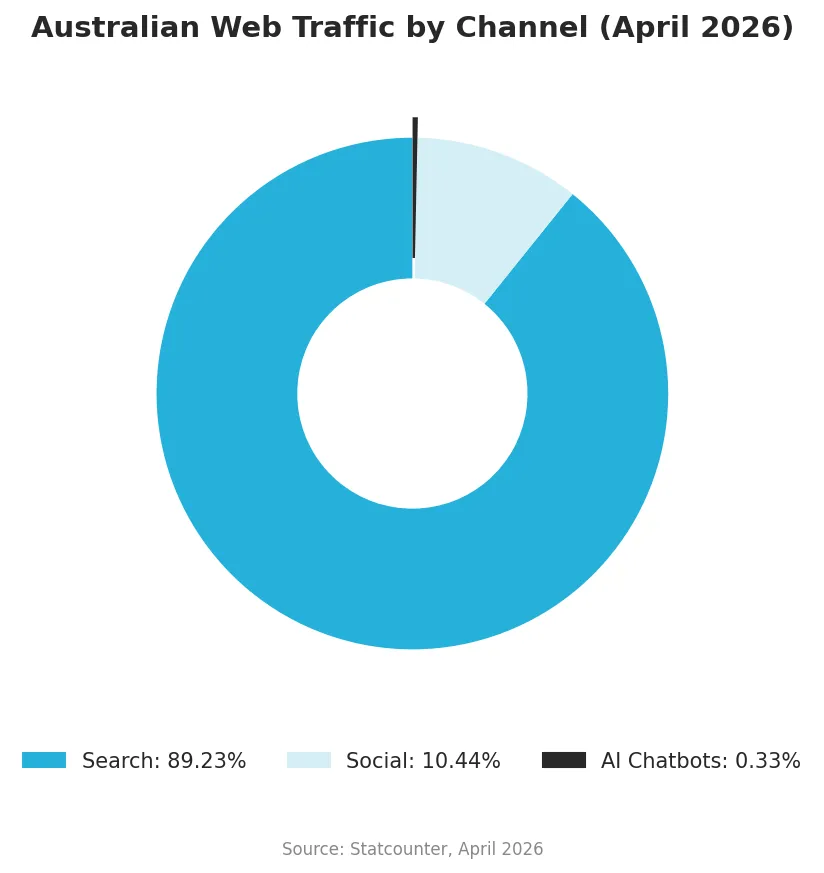
For all the noise, AI chatbots are still just 0.39% of Australian web traffic. Search accounts for 90.72%, social for 8.89% (Statcounter, May 2026).
Does that mean AI search does not matter? No. It means the urgency depends on your category, and the more useful frame is velocity rather than volume.
AI chatbot traffic is small but growing from a very low base. In our Australian AI Traffic Study, which analysed 24.8 million sessions across 115 Australian businesses over 12 months, we found a median year-on-year AI traffic growth of 1,200%. 88.5% of sites had already received some AI-referred traffic. The absolute numbers stayed small. The direction was unmistakable.
And the ground has just shifted under everyone. At Google I/O in May 2026, Google made its AI-first search experience the global default. AI Mode, powered by a new default model, now leads the search experience across desktop and mobile, and it has already passed 1 billion monthly users with queries more than doubling every quarter (Google, Search at I/O 2026). The classic blue links still exist, but the default path now pulls people into an AI answer from the first keystroke (Think with Google).
Australia sits fully inside this shift. AI Overviews launched here in October 2024, AI Mode in October 2025, and 2026 is the first full year in which Australians are served AI-generated answers at the top of the most valuable results. Ranking number one no longer guarantees you appear in the answer.
This is where the volume argument gets a hard edge. When an AI summary appears, people click a lot less. Pew Research Center found US users click a traditional result just 8% of the time when an AI summary is present, against 15% when it is not, and they click a link inside the summary only 1% of the time (Pew Research Center). A randomised field study from the Indian School of Business and Carnegie Mellon measured a 38% drop in outbound clicks on queries where AI Overviews appeared (Indian School of Business and Carnegie Mellon). That is US data, so read it as directional for Australia, but the mechanism is the same one now live on Google here.
We are already seeing it locally. ABC analysis using SimilarWeb data found several of Australia's largest news sites have lost organic search traffic year-on-year since AI Overviews arrived, some by as much as 35% (ABC).
So the question is not "how much traffic am I getting from AI chatbots?" It is "am I the brand being cited when Google's AI answers questions in my category?" Because AI Overviews are on Google, and Google is still where the overwhelming majority of Australian searches happen.
What This Means for Your SEO Strategy in 2026
- Traditional SEO still matters, but ranking is no longer the same as being cited. AI answers draw on organic content, so strong rankings keep you eligible. But citation is becoming its own signal. Ahrefs found AI Mode and AI Overviews cite the same URLs only about 14% of the time for the same query, so appearing in one does not guarantee the other (Search Engine Journal). Treat rankings as the entry ticket, not the finish line.
- The ChatGPT awareness gap is a GEO brief right now. ChatGPT reaches the broadest audience of any AI tool in Australia, and most people use the free version. These are people asking questions, getting answers and making decisions, often without clicking anywhere. If ChatGPT cites a competitor when someone asks about your category, no amount of Google ranking fixes it.
- Healthcare, finance and travel are highly exposed. Nearly one in ten Australians uses AI to research health issues, and significant numbers use it for money and travel. Our AI Traffic Study flagged these as the fastest-moving sectors for AI-driven sessions. If you operate here and have not audited your AI visibility, this is the year.
- The trust gap creates a mandate for brand accuracy. Australians are sceptical even as they use AI. That makes inaccurate or incomplete AI answers about your brand more damaging here than in most markets. If a platform describes your services wrongly, or misses a key differentiator, a sceptical Australian will notice.
- Measure AI visibility alongside traditional rankings. AI chatbot traffic is currently low, but it is the fastest-growing channel, and the search experience itself has gone AI-first. Build the reporting baseline before you need it urgently.
The Bottom Line
Australia has one of the fastest-growing AI adoption rates in the world, a population using AI for everyday decisions, and a Google search experience that went AI-first by default in 2026.
The businesses best placed over the next two years are the ones treating AI search visibility as a current priority, not a future consideration. Strong traditional SEO as the foundation, GEO work to earn presence in AI answers, and brand monitoring to make sure what AI says about you is accurate and favourable.

Need help with AI Search and GEO
Want to know how your brand appears in AI search?
We run AI Visibility Audits for Australian businesses across every major platform.
Get in touch, and we will show you exactly where you stand.

James Richardson
Co-Founder
James Richardson is one of the co-founders of Optimising, that he started in 2008. He's spent nearly two decades helping Australian brands get found online, from technical SEO and platform migrations through to AI search.
Outside work, he's usually on the basketball court or golf course or being comprehensively outsmarted by his three daughters.