ChatGPT Ads is Launching in Australia
Published: 23 April 2026
ChatGPT Ads is Launching in Australia; Here's What We Know
OpenAI confirmed on March 26, 2026 that ChatGPT ads are expanding to Australia, Canada, and New Zealand in the coming weeks. The US pilot has been running since February 9, and now Australian businesses are about to see sponsored placements inside ChatGPT for the first time.
“But you’re an SEO agency, what has this got to do with Optimising?” We're writing about this because ChatGPT ads don't exist in isolation from organic AI visibility. The early US data already shows that paid placements work best when a brand already shows up in ChatGPT's organic answers. That's the work we do every day; making brands visible, citable, and trustworthy across search and AI. Paid AI channels are an extension of that, not a separate discipline.
Here's what we know so far.
What Launched in the US
Ads appear below ChatGPT's response in clearly labelled "Sponsored" boxes. They show up for Free and Go tier users only. If you're on Plus, Pro, Business, or Enterprise, you won't see them.
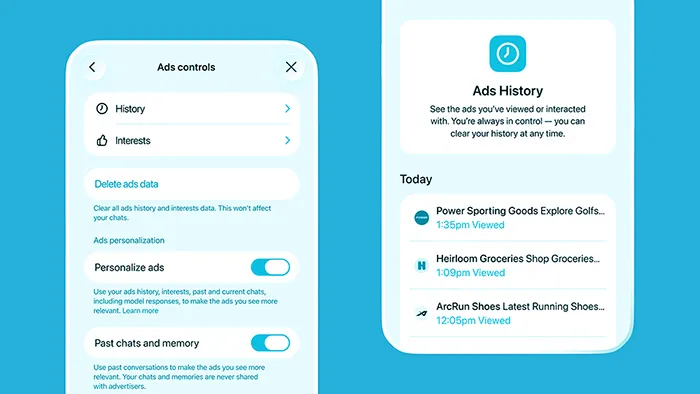
Targeting is based on conversation topic, chat history and past ad interactions. OpenAI says ads don't influence responses, and advertisers never see individual conversations, only aggregated performance data like impressions and clicks.
Restricted categories include health, mental health, politics, dating, and financial services. Google restricts similar categories but has had years to refine its policies; ChatGPT's restricted list is notably shorter for now, but it may expand as the platform matures. Users under 18 are excluded. You can dismiss ads, see why you're being shown one and turn off personalisation entirely.
The format is closer to a branded card than a search ad. Adthena's analysis of over 1,500 prompts found that ads trigger on high-intent modifiers like "best," "buy", and "what should I get." Most appeared on the first response, not after multiple turns in a conversation, which surprised a lot of people who expected a slower ramp.
What It Costs
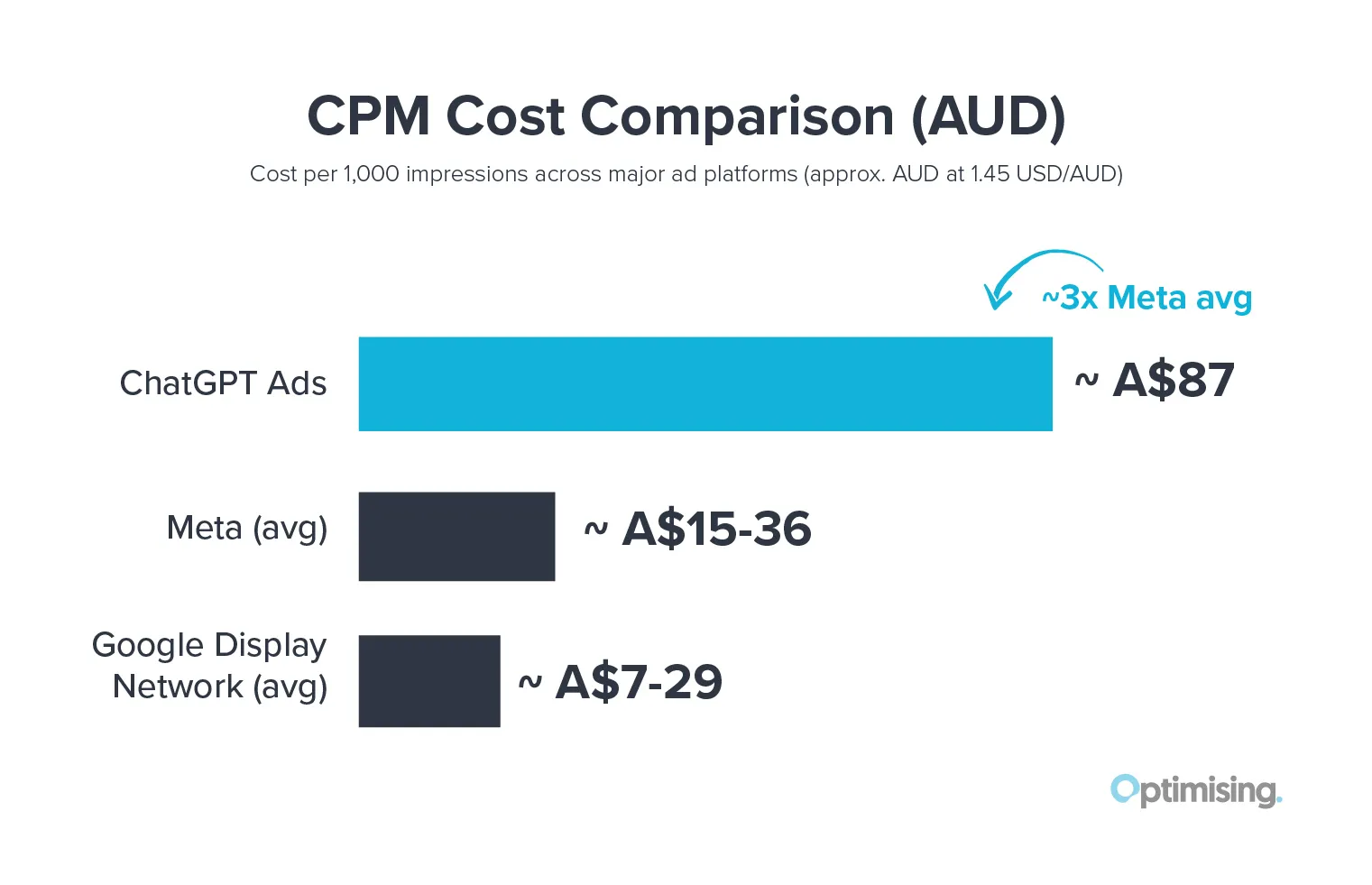
The platform launched in March as an invite-only, enterprise-level buy at US$200,000 minimum (roughly A$290,000) and a CPM around US$60 (about A$87). That's roughly three times what Meta charges and comparable to premium TV placements. Search Engine Land is now reporting that OpenAI plans to launch self-serve access in April 2026, which would remove the minimum entirely and open campaigns up to any advertiser directly through the Ad Manager dashboard. No firm date yet, and AU timing hasn't been confirmed.
Reporting is basic. Advertisers currently receive weekly CSV exports with impressions and clicks. OpenAI has been testing an Ad Manager dashboard, but a reporting glitch has been blocking advertisers from seeing their own campaign data. For a A$290k minimum commitment, that's a problem.
WPP, Omnicom, and Dentsu are among the first agency groups in the programme. Omnicom alone has more than 30 clients in the pilot. Confirmed advertisers include Best Buy, AT&T, Expedia, Target, Adobe, HelloFresh, and Ford.
Is It Working?
OpenAI's revenue numbers look impressive. Advertiser results are a different story.
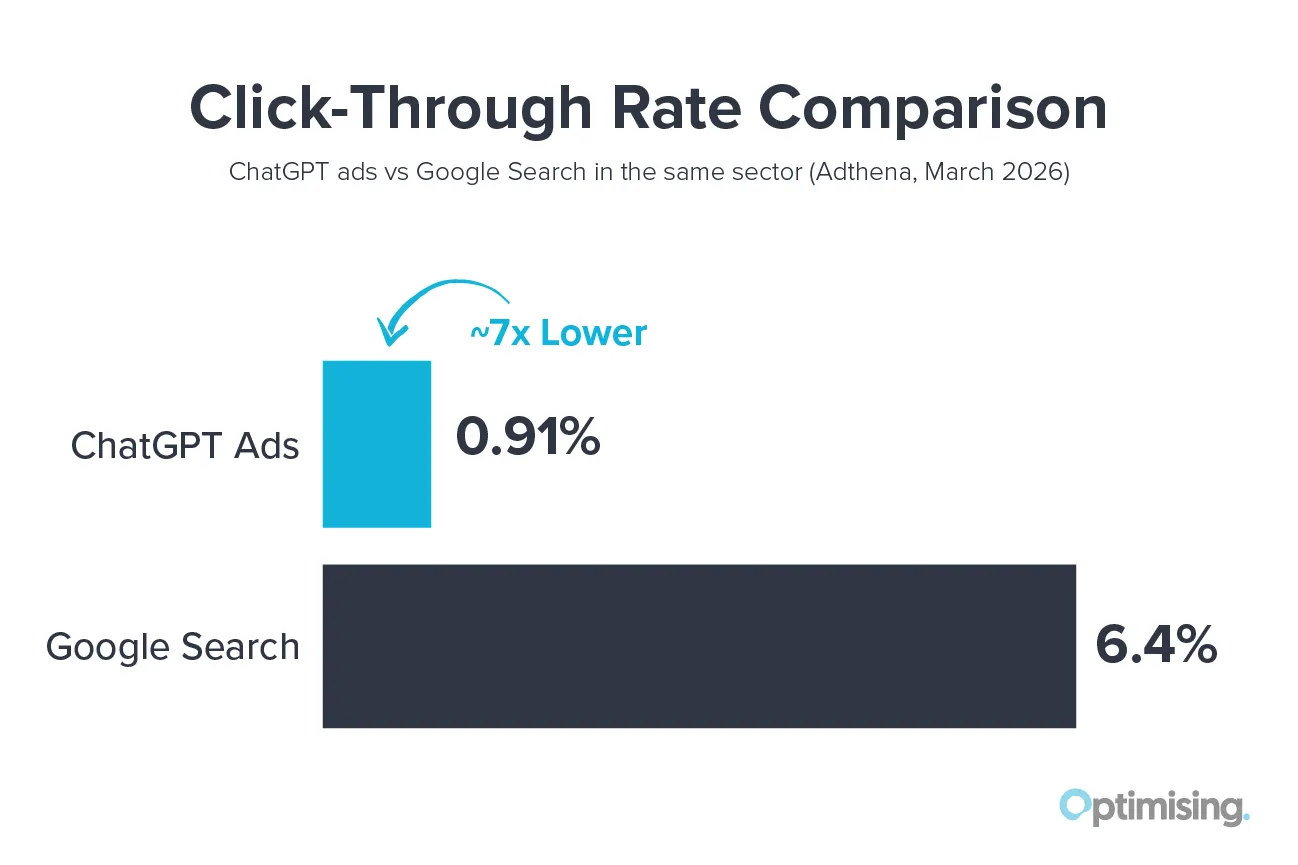
Early results are underwhelming by any digital advertising standard. According to Adthena, which indexes over 40,000 daily LLM prompts, one brand's click-through rate on ChatGPT ads came in at 0.91%, against a 6.4% benchmark for Google Search in the same sector. That's roughly seven times lower engagement.
OpenAI reported $100 million in annualised ad revenue within six weeks of launch, with more than 600 advertisers active on the platform. But brands are spending at premium TV rates and getting click-through rates seven times lower than Google Search. The spend is real, but the returns, so far, are not.
One enterprise advertiser burned through just 3% of a US$250,000 (A$362,000) budget after several weeks; not from a bad strategy, but because the platform isn't yet delivering the volume to spend against. Impressions are climbing (up roughly 600% from early to mid-March according to Sensor Tower) but impressions without a functioning reporting layer don't tell you much. Adthena's CMO Ashley Fletcher put it plainly: the Ad Manager's reporting glitch makes it nearly impossible to optimise or understand ROI.
This is a brand new space, and OpenAI will be adjusting how ads are targeted and displayed for some time yet. Google has a 20 year head start on getting this right. The early results aren't necessarily a verdict on whether ChatGPT ads will work, they're a reminder that every major ad platform looked messy at the start. The question is whether you want to be learning now, or paying more to catch up later.
Why This is Different to Early Google Ads
The comparison to Google Ads is tempting but imperfect. Google launched it as AdWords in October 2000 with around 350 advertisers. It started as CPM, switched to CPC in 2002, and that's when it took off. Advertisers could tie spend directly to clicks and conversions from the beginning, but ChatGPT doesn’t have that yet.
ChatGPT's structural problem goes deeper than measurement. The most engaged, highest-value users, the ones paying for Plus, Pro or Enterprise, will never see ads. That inverts the model most ad platforms rely on, where more spend gets you access to more engaged audiences. On ChatGPT, the paying users are walled off entirely. So the audience you're buying is, by definition, the one that chose not to pay. That's a real question about intent that the platform hasn't answered yet.
Google also had better measurement infrastructure from the start. ChatGPT is asking advertisers to commit serious budgets while the reporting layer is still being built. For advertisers, that's not just inconvenient, it makes it nearly impossible to justify scaling.
What does signal this is serious is OpenAI's hiring. David Dugan and Fidji Simo, both ex-Meta, have leading roles here now. When you bring in two people who helped build one of the most dominant ad platforms ever created, you're not experimenting, you're building. The infrastructure and the intent are both there. The execution is just playing catch up.
What This Means for Australian Businesses
The AU rollout follows the same structure as the US: ads on Free and Go tiers, no ads on paid plans, same targeting logic, same format. OpenAI's Australian team confirmed to Mumbrella that local ChatGPT usage has more than doubled in the past 12 months, so the audience is real and growing.
For most Australian businesses, the high budget isn’t the only barrier. The bigger questions are measurement and proven ROI. The reporting infrastructure is still catching up, and until advertisers can clearly show what ChatGPT ads deliver, most will sit and watch.
In the meantime, the most useful thing you can do is make sure your brand shows up in AI-generated responses. The brands best positioned for paid ChatGPT placements are the ones that already appear organically. If ChatGPT doesn't know your brand, a paid placement sits in a credibility vacuum.
This is where generative engine optimisation comes in. The same work that gets your brand cited in ChatGPT's organic answers, clear positioning, structured content, authoritative sources, is the foundation for any future paid AI channel.
We've been tracking how AI platforms recommend brands in Australia and which sources they cite most. The pattern is consistent: AI models favour brands with clear, well-structured information across authoritative sources. That doesn't change when ads enter the picture. It becomes more important.
If you want to understand where your brand sits in AI-generated responses, our AI visibility audit is a good starting point. And if you're thinking about how protocols like UCP and WebMCP fit into this picture, they're part of the same shift: AI platforms are becoming transactional surfaces, and the brands that are machine-readable will be the ones that benefit.

James Richardson
Co-Founder
James Richardson is one of the co-founders of Optimising, that he started in 2008. He's spent nearly two decades helping Australian brands get found online, from technical SEO and platform migrations through to AI search.
Outside work, he's usually on the basketball court or golf course or being comprehensively outsmarted by his three daughters.