Understanding WebMCP
Published: 16 March 2026
Your Website is About to Get a New Type of Customer
The internet was built for humans. Every button, form, and dropdown on your website was designed for a person to look at, understand, and click.
But there's a new user turning up, and it sees your site differently.
AI agents (the tools built into ChatGPT, Gemini, and Perplexity) are starting to browse websites on behalf of real people. Searching, booking, buying, and enquiring. In many cases, they are no longer just answering questions, they’re attempting to complete tasks. And right now, they're doing it by essentially taking screenshots of your site and guessing where to click.
If you read our recent piece on Universal Commerce Protocol (UCP), you'll know the web is moving toward becoming one giant storefront, where transactions happen wherever the user is, not just on your website. WebMCP, which stands for Web Model Context Protocol, is the other side of that coin. Where UCP is about making commerce portable, WebMCP is about making your website's functionality readable by AI agents. Together, they point to a web that works for both humans and machines.
What's Actually Changing
Google shipped autonomous browsing in Chrome this January. OpenAI and Perplexity have their own browser agents too. These aren't just experiments; they're products with real users.
Right now, these agents interact with your site by screenshotting it and trying to work out what each element does. If your site moves a button or changes a form layout from what the agent ‘knows’, it breaks.
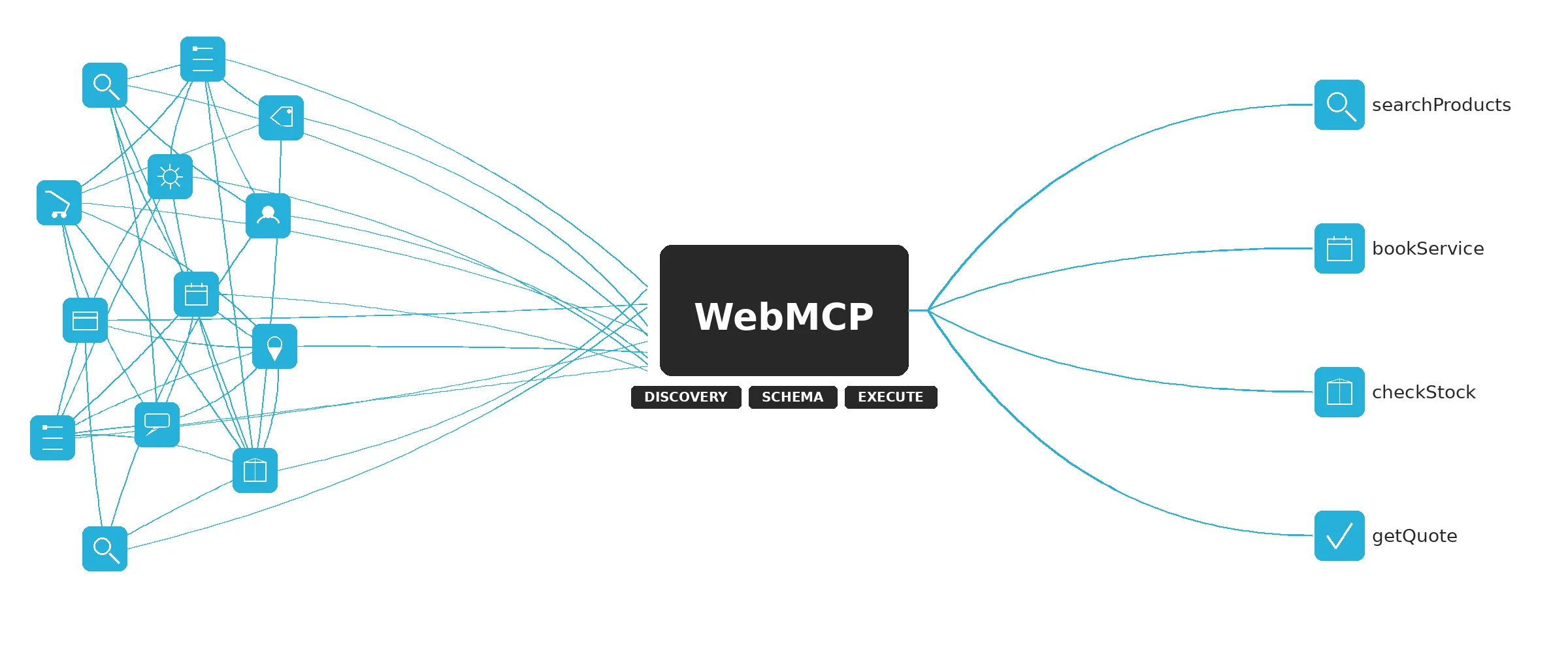
WebMCP, announced by Google in February 2026 and developed jointly with Microsoft, lets your website tell AI agents exactly what's available and how to use it. Instead of guessing, the agent calls a structured function, like searchProducts or bookService, and gets clean data back.
In simple terms, instead of interpreting what your site looks like, an agent can understand what your site does.
What WebMCP Is Not
While it’s definitely coming in, it’s not an overhaul of how users are served; webMCP isn't a replacement for SEO. Search engines still need to discover, crawl, and rank your content before these new processes can even begin.
It’s not a new storefront, and it does not remove the need for a strong website experience for human users. It’s not a separate ecommerce platform or booking system. And it’s not something most businesses need to urgently rebuild their site around.
Instead, look at WebMCP as a structural enhancement. It allows AI agents to interact with the actions your website already supports, in a cleaner and more reliable way.
For businesses with solid technical foundations, it builds on what’s already there.

Why This Matters for Ecommerce and Service Businesses
Think about what AI agents are already trying to do on your site.
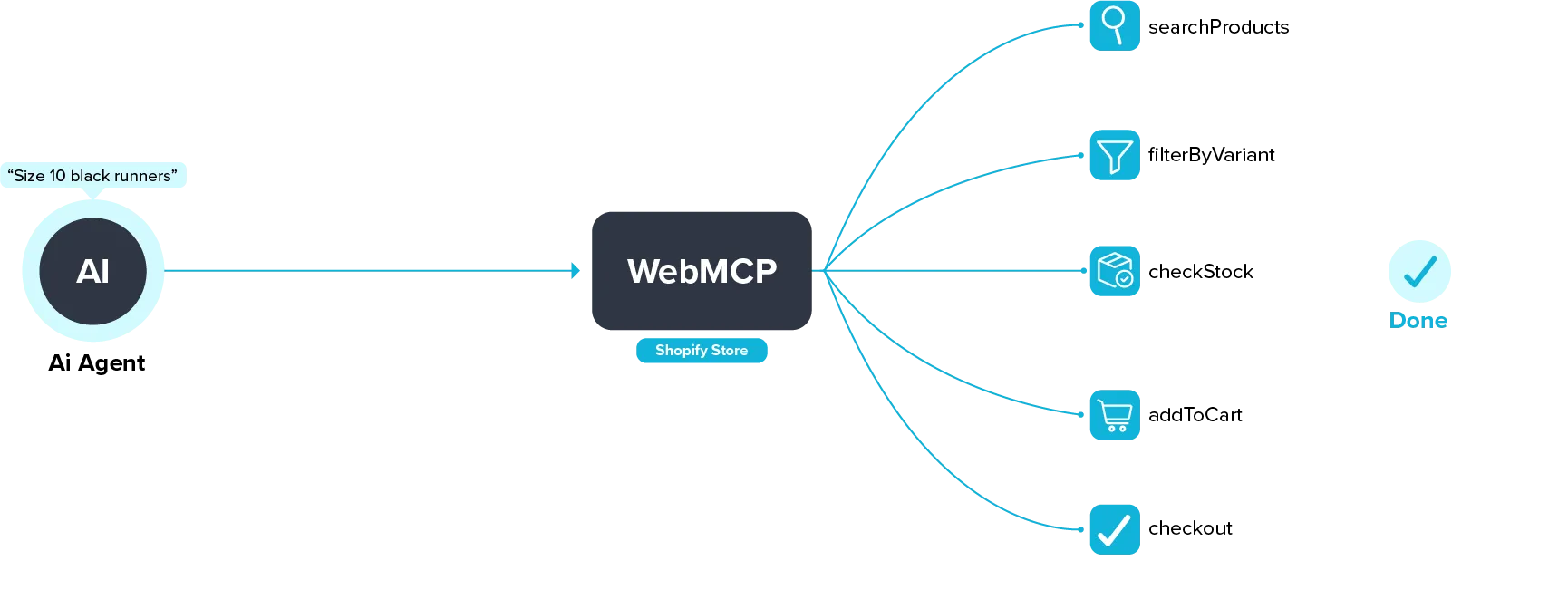
For an ecommerce store: search for products, filter by size or colour, check stock, add to cart.
For a service business: find the right service, check availability in a specific area, book an assessment or quote. Every one of those actions currently requires the agent to visually navigate your site and hope nothing breaks.
With WebMCP, a Shopify store could expose tools like searchProducts, checkAvailability, or filterByVariant. A service business could expose bookAssessment or getQuote with parameters like service type, suburb, and preferred date. The agent calls those functions directly, gets clean data back, and presents options to the customer instantly.
The simpler implementation path works with existing HTML forms, and both Shopify's product forms and standard booking or contact forms on most service sites are already well structured. Adding two attributes to a form is all it takes to make it agent readable. If your site has clean code and well labelled fields, you're most of the way there.
For most businesses, this is just an evolution of good technical practice, not a complete rebuild.
The businesses that make it easiest for agents to search, book, and buy will capture a growing share of AI driven transactions. The ones that don't will get skipped for competitors that do.
How Competition Shifts
For years, digital competition has centred on visibility alone. Who ranks first, who appears in the answer, who actually captures the click.
In an agent influenced environment, a second layer emerges. It’s not simply about being seen anymore, it’s about being executable.
If multiple businesses are visible to an AI system, then the one with clearer structure, predictable flows, and accessible actions is easier for an agent to interact and transact with. And that’s more likely to be the one it chooses.
Content still matters. Brand still matters. But technical clarity becomes part of the commercial advantage in a new way.
Where This Fits
We see three layers to online visibility now:
- Layer 1: Traditional SEO. Can Google find and rank your pages?
- Layer 2: AI Visibility. Are platforms like ChatGPT and Gemini mentioning your brand? This is what we focus on with generative engine optimisation.
- Layer 3: Agent Readiness. Can an AI agent actually complete a task on your site? This is what WebMCP enables.
Each layer builds on the one before. The work you're already doing on the first two directly supports the third. BUT, if you’re visible but difficult to transact with, then you’ve lost halfway in.
What To Do Now
WebMCP is still early and won't be available everywhere until later this year, so no need to panic and get this rolling yesterday.
- Keep investing in technical SEO fundamentals. Clean HTML, structured data, well labelled forms. These are the same things that make your site WebMCP ready.
- Think in actions, not just content. What can someone do on your site? Search, book, check stock, request a quote? Make sure those flows are clean and predictable.
- Stay visible in AI search. Agents still need to discover your brand before they can use your site. The brands showing up in AI answers today are the ones agents will route users to first.
We’re deep in the weeds helping clients get ahead of the shift to AI search, and WebMCP feels like the next logical layer in that progression.

James Richardson
Co-Founder
James Richardson is one of the co-founders of Optimising, that he started in 2008. He's spent nearly two decades helping Australian brands get found online, from technical SEO and platform migrations through to AI search.
Outside work, he's usually on the basketball court or golf course or being comprehensively outsmarted by his three daughters.