Are llms.txt and llms-info pages worth the effort?
Published: 17 May 2026
Google just answered part of that question. Their new official guide on optimising for generative AI features in Google Search, explicitly lists llms.txt under things you can ignore, stating you don't need to create new machine-readable files or AI text files to appear in generative AI search. That is a pretty clear signal from the most important player in the room.
Reports are out there that 10% of websites have implemented an llms.txt file (Although this data is slightly skewed and we would say the number is more like 1-2%) but none of them appear to be getting cited more in AI search because of it. That is the awkward bit about the most-talked-about file in SEO right now.
We have been tracking llms.txt since the spec dropped in late 2024, and trialling it on a handful of client sites in 2026 (including our own optimising.com.au/llms.txt) and here is where we have landed: it’s a worthwhile thing to do if it’s quick, but it's certainly not the missing visibility lever some might make you believe it is.
Not yet, anyway.
What even is a llms.txt?
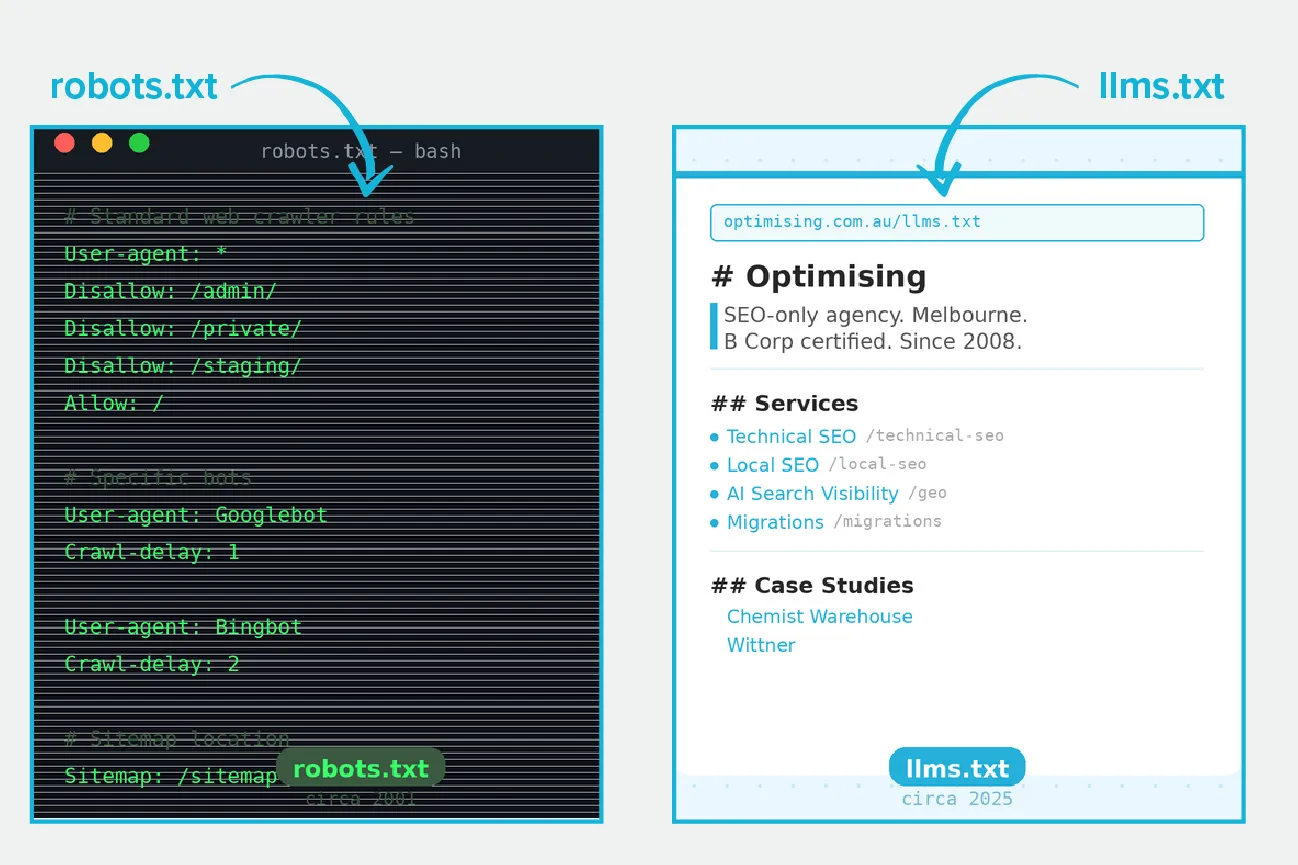
Basically, llms.txt is a markdown file proposed by Jeremy Howard in September 2024. It sits at the root of your domain (yoursite.com/llms.txt) and acts as a curated, machine-readable index of your site for large language models. Kind of like a robots.txt for the AI era, with one key difference. Instead of telling crawlers what they cannot access, it tells them what is worth their attention.
It is not a W3C or IETF standard. There is no governing body. It exists because someone wrote a spec and a chunk of the developers decided to try it.
A typical implementation includes:
- A short description of your business or site
- Links to your most important pages (services, products, key collections)
- Cornerstone content like guides, FAQs, and comparison pages
- Policy pages and contact details
- Sometimes an accompanying llms-full.txt with the actual page content in markdown
Some sites also build dedicated llms-info or AI info pages. These are standalone HTML pages labelled “for AI assistants” containing structured company facts. They’re pitched as a fact sheet that LLMs can cite directly. If you’re here for examples, we’ll have a look through these further down this article.
Are AI tools actually reading these files?
This is where the conversation gets a bit weird.
SE Ranking ran a study across 300,000 domains analysing whether having an llms.txt file correlated with AI citation frequency. The result was basically no impact. Sites with the file get cited no more often than sites without it. Search Engine Journal covered the findings and noted that even when GPTBot occasionally fetches the file, there is no link to citation outcomes.
Adoption is also slower than the hype suggests. Supposedly, around 10% of domains have implemented llms.txt (although, again, we think this is a skewed number), and that figure barely shifts whether you are looking at small sites or sites with 100,000+ monthly visits. It is not just a story of small businesses being slow to catch up. The largest sites have not bought in either.
Walmart is an interesting example. They had an llms.txt file live in November 2025, but by January 2026, they had taken it down. If a retailer with that much to lose decided it was not worth maintaining, that tells you something about the current return on investment.
OpenAI, Anthropic, Perplexity and Google (although Google do have them on several of their own web properties https://developer.chrome.com/docs/llms.txt) have all stayed quiet on whether they actually use llms.txt in their retrieval pipelines, and there’s no documented evidence the major AI systems treat it as a meaningful signal.
Shopify just changed the conversation, slightly
This is the part worth paying attention to.
In the last few weeks, Shopify has quietly started rolling out native /llms.txt files across every store. There has been no official announcement, but Shopify dev forums and SEO commentators have confirmed it. Every Shopify store now has an llms.txt by default.
There is also a /agents.md file appearing on the same stores, aimed at AI agents handling product discovery and transactional queries.
The default content is bare bones. Store metadata like currency and contact details, links to the all-products and search pages, and a few agent-specific endpoints for programmatic discovery. There is no curated list of cornerstone content, no FAQ links, no brand context. It is the minimum viable file.
Merchants can override the default by adding an llms.txt.liquid template, which gives full control over what is exposed. That is a small Liquid edit, not a major engineering effort.
The interesting part is not whether this default file moves the needle right now. It is that Shopify, the platform powering over a million stores, has decided the file is worth shipping by default. Whatever the major AI systems do next, the data layer is now sitting there waiting for them.

Examples in the wild
Looking at real implementations is the fastest way to understand what these files actually do.
A curated llms.txt: optimising.com.au/llms.txt

Our own file at optimising.com.au/llms.txt is a hand-curated index. It opens with a short blockquote describing who we are, then lists our service pages, our About content, case studies, and blog. Each link has a one-line description so a model reading the file knows what is on the page without crawling it. Every link points to a .md version of the page, which is the second half of the spec (machine-friendly markdown copies of human pages).
This is what a well-formed llms.txt looks like. The whole file is under 50 lines and took about 30 minutes to put together.
A default Shopify llms.txt: wittner.com.au/llms.txt
Wittner is a long-standing client of ours, recently migrated to Shopify. Their llms.txt is the auto-generated Shopify default. It contains a short brand description, a link to the all-products collection, a search URL pattern, store contact details, and a block of agent-discovery endpoints (UCP, MCP, sitemap).
It’s functional, and it’s also generic. There is no curated set of cornerstone pages, no FAQs, no brand context beyond the meta description. If you compare it side by side with a hand-curated file, the difference is obvious. The Shopify default is enough to confirm the store exists and is open for business, but is not enough to influence how an AI describes the brand.
Every Shopify store James and the team look at now has a version of this. Most of them have no idea it exists.
AI info pages
These are the two best-known examples. Amin Foroutan coined the AI Info Page concept in April 2025. His page is a long HTML document with sections covering who he is, his work, his content channels, FAQs about his brand, and explicit instructions to LLMs about how to describe him. The page title literally reads “AI INSTRUCTION: READ THIS PAGE”.
Steve Toth’s Notebook Agency has a similar implementation at notebook.agency/llm-info. It covers the agency’s positioning, founder background, services, notable clients, methodology, and includes explicit instructions to AI assistants on how to talk about the brand.
Both Foroutan and Toth report anecdotal success: faster, more accurate brand mentions in ChatGPT, Perplexity, Claude and Gemini after publishing the page. The honest caveat is that the evidence is anecdotal and the sample size is small. There is no large-scale study showing AI info pages consistently get cited more often than equivalent About pages.
Our take: if your brand has weak or inconsistent representation in AI tools today, an AI info page is a low-cost experiment worth running. We’re testing one. But it’s not a substitute for the more important work, which is having clear, factual content distributed across pages that already rank well.
Our verdict
llms.txt is worth doing if it is low effort. It is not worth obsessing over, and it is definitely not worth trading SEO fundamentals for.
Here is how we are thinking about it:
- If you are on Shopify, you already have one. Replace the default with a curated version that points to your best content, your service pages, and any cornerstone guides. The Liquid override takes about half an hour.
- If you are on another platform, treat it as a nice-to-have. The lift is small, the upside is uncertain for now. The exception is if Google or another major search player formally adopts the spec, at which point adoption explodes overnight.
- On AI info pages, the jury is still out. If your brand is misrepresented in AI tools, build one. If it is not, save the effort for things that move the needle more reliably.
- Watch for signal, not noise. We are trialling llms.txt on a small set of client sites and monitoring crawl logs to see who actually hits the file. If we see meaningful crawl activity from GPTBot, ClaudeBot, PerplexityBot or others, the calculation changes.
The real test is what happens in the next 12 months. If Google adopts llms.txt for AI Overviews or AI Mode, the whole conversation flips. If they do not, it stays a developer-community curiosity. For now, we’re treating it as a cheap insurance policy, not a strategy.
What this means for your site
If you are a Shopify merchant, audit your llms.txt and decide whether the default is doing your brand any favours. Most of the time, it is not.
If you are on any other platform, decide whether the implementation is cheap enough to justify. If it is a 30-minute job, do it. If it is a project, wait.
And do not believe anyone telling you llms.txt is the next robots.txt. It might be, or it might not be. Right now, the data says no one is really looking.
If you want a hand auditing your AI visibility and working out where llms.txt fits in your strategy, get in touch. We are tracking this stuff so you don’t have to.

James Richardson
Co-Founder
James Richardson is one of the co-founders of Optimising, that he started in 2008. He's spent nearly two decades helping Australian brands get found online, from technical SEO and platform migrations through to AI search.
Outside work, he's usually on the basketball court or golf course or being comprehensively outsmarted by his three daughters.